The True Cost of a Bookkeeper: Beyond $4,500 a Month
You are staring at a spreadsheet late on a Tuesday, running the math on your next hire. The number anchoring your screen is $4,500 a month for a new bookkeeper.
On paper, that’s $54,000 a year. You’ve got a job post live and two final candidates, and the knot stays because the cost of a bookkeeper never stops at the number on the offer letter.
Most owners we work with budget for the salary, and everything that rides along with it tends to surface later. Payroll taxes, health insurance, a retirement match, paid time off, a QuickBooks seat, and three quiet months of ramp-up before the work really flows.
How Much Does a Loaded Bookkeeper Salary Actually Cost?
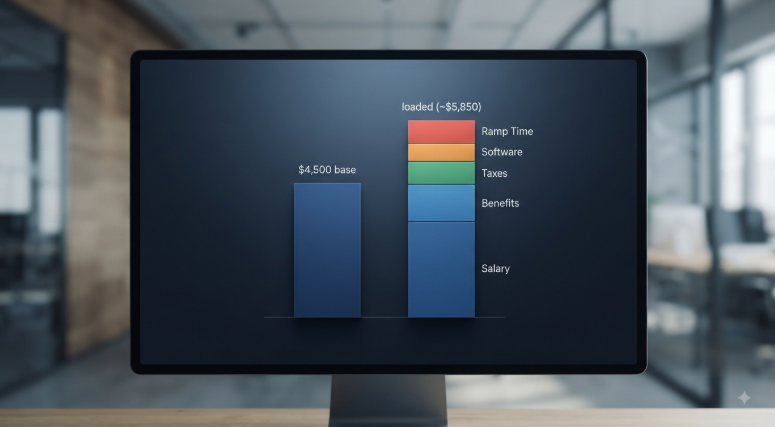
The Bureau of Labor Statistics puts the median wage for bookkeeping, accounting, and auditing clerks at $49,210 a year in May 2024, so a $4,500 monthly ask already sits above the national average. And any owner who has run payroll knows the base number is just the entry fee. Benefits, employer-side payroll taxes, and paid leave typically tack on another 25 to 30 percent before the work even starts.
Run that math on a $4,500 base, and the true monthly line item lands between $5,625 and $5,850 before anyone reconciles a single account.
Then the smaller line items stack up:
- A monthly software seat and payroll service fees
- PTO coverage, when the work still lands on someone’s desk
- Onboarding hours pulled from your own week
Add it together, and year one lands between $67,500 and $70,200 before software and ramp time are counted. That’s the real cost of a bookkeeper, and it’s the number worth comparing against alternatives.
Why Outsourcing Became a Strategy, not a Last Resort
Somewhere along the way, outsourcing shed its desperation-move reputation. According to Deloitte’s 2024 Global Outsourcing Survey, skilled talent and agility now rank right beside cost savings as the top reasons companies outsource.
That tracks with what we hear from stretched owners. Outsourcing stops being a cut and starts being a roster move, converting a fixed payroll burden into a predictable line item.
It also changes what your week looks like. The hours that were going into data entry go back to pricing jobs, chasing leads, or planning next quarter, which is where an owner’s time actually pays.
The Deep Finance and Accounting Bench in the Philippines
Here is the part many owners miss. According to industry research from the IT and Business Process Association of the Philippines, finance and accounting is a core, established service line backed by a highly skilled talent pool. The sector has deep domain expertise in banking and financial services, meaning the professionals handling your ledger are trained for complex work.
A dedicated offshore bookkeeper from that bench isn’t a gamble on cheap labor. It is a trained professional who closes books for a living, at a line item that doesn’t carry the benefits-and-taxes layer.
Do Offshore Bookkeepers Have English Fluency for Complex Accounting?
That is the quiet fear in every outsourcing conversation, and it is fair to name it. The 2025 EF English Proficiency Index answers it with hard data. The Philippines scores 569 and ranks 28th out of 123 countries, landing in the High Proficiency band and sitting second in Asia behind Malaysia. When your offshore bookkeeper needs to ask a clarifying question about a miscategorized expense or explain a variance in the month-end close, that level of fluency means the financial nuance does not get lost in translation.
A ranking won’t run your books, but it removes one worry from the list. The questions you’d ask in a hallway, you can ask in a shared channel, and your month-end close doesn’t get lost in translation.
Run the Loaded Math Before You Sign Anything
One practical first step we’ve seen work: Write the loaded number on one side of a page. Salary, payroll taxes, benefits, software, ramp time, PTO coverage.
On the other side, price outsourced bookkeeping as its own contained line item. Many owners start with one slice, like accounts payable or monthly reconciliations, and let the arrangement prove itself for a quarter before handing over the whole ledger.
If the math closes the gap you expected, the next conversation gets easy. If it doesn’t, you’ve lost ten minutes and learned what your bench actually costs.
A roster is only as good as the minutes it gives you back. The goal was never a cheaper bookkeeper. It’s a Friday afternoon where the numbers are done, and you’re planning next quarter instead of reconciling it.
Still weighing the loaded math?
Start with a free business audit. We will map the bookkeeping work and define the role before you commit.