The 20-Minute SOP Template for Delegation
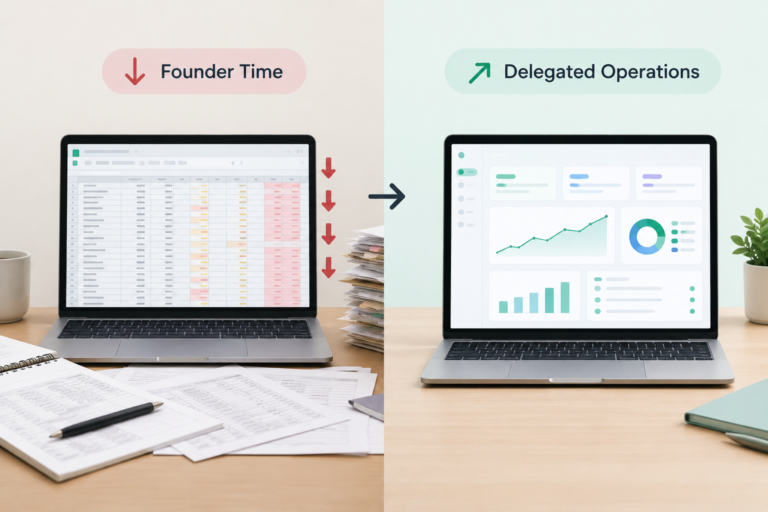
It’s 10 PM. You’re staring at a spreadsheet, fixing an invoice your new assistant just sent over. The formatting is wrong, a key column is missing, and the client data doesn’t match. You sigh and start reformatting it yourself because it feels faster than explaining it again.
According to a Forbes survey on entrepreneur productivity, the average founder spends 36% of their work week (roughly 16 hours) on small administrative tasks.
When delegated work comes back wrong, it’s tempting to blame the hire, and sometimes that’s fair.
But more often than not, you don’t have a people problem. You have a documentation gap. And without a written process, you can’t even tell the difference between the two.
Finding the right SOP template for delegation is the first step to actually getting your time back.
The Real Cost of Missing Process Documentation
When you try to hand off a task without a clear guide, friction happens. A 2024 Salesforce and Slack survey found that small business owners lose an average of 96 minutes every single day to wasted time and inefficient processes. That’s eight hours a week bleeding out simply because workflows aren’t written down.
Every time you stop to answer a question about how to format a report, you’re paying a hidden tax. That tax compounds as your team grows.
Building your roster of remote talent requires a solid playbook. If the playbook only exists in your head, the new player can’t run the route. You can’t expect a skilled professional to execute flawlessly if the rules of the game are constantly changing. Nobody wants more red tape.
But a written process is the infrastructure that lets you scale without burning out.
Why Founders Resist Handing Off the Ball
We often hear from operators that they want to delegate tasks, but it just feels impossible. The barrier is rarely a lack of capable talent in the market. According to Harvard Business Review, the primary roadblocks are psychological: distrust, control issues, perfectionism, and a fear of failure.
It’s easier to just do it yourself in the moment. But that short-term fix creates a long-term bottleneck.
You become the single point of failure for your own company.
You worry that if you let go, the quality will drop or the client will notice.
If that worry traces back to a handoff that went sideways, these three offshore hiring mistakes are worth checking against what actually happened.
A lean standard operating procedure isn’t a rigid cage. It’s the psychological safety net that allows you to step back without losing control.
When the steps are documented, you’re no longer relying on memory or constant oversight. You’re relying on a proven system.
What Should an SOP Template for Delegation Include?
Most owners think they need a 40-page manual before they can hand off a single task.
They don’t.
You just need a lean skeleton that takes about 20 minutes to fill out. You don’t need to record a 30-minute video or write a novel. Bullet points and screenshots are usually more than enough to get the point across.
An effective SOP template for delegation includes five core components: the objective, the trigger event, high-level steps, required tools, and clear done-criteria. This lean framework removes guesswork and allows remote professionals to execute tasks flawlessly without instant oversight.
Gallup’s research on managing remote and hybrid teams shows that professionals perform at their highest levels when managers explicitly clarify expectations and define outcomes, rather than just managing hours. Geographic distance becomes irrelevant when the finish line is clearly marked.
If you’re not sure which task to document first, a task audit is the cleanest way to pick one.
Here is the 20-minute framework to document any task before passing it to an offshore professional:
Objective: What’s the ultimate goal of this task in one sentence? (e.g., “Generate a weekly report of all unpaid invoices.”)
Trigger: What event starts this process? (e.g., “Every Friday at 4 PM,” or “When a new client signs the contract.”)
Steps: The chronological actions required. Keep it to high-level clicks and decisions, not a micro-managed script. (e.g., Pull the invoice list, format the columns, export the PDF, upload, notify.)
Tools: The exact software, logins, and templates needed to do the job.
Done-Criteria: What does “finished” look like? (e.g., “The PDF is uploaded to the shared drive and an email notification is sent to the CFO.”)
The Pullback Before the Launch
Handing off a task feels risky until you build a rhythm with the person doing the work. Expecting a flawless handoff on day one is a trap. There will be misunderstandings. There will be missed details.
But that is exactly why you spend 20 minutes writing down the trigger, the steps, and what “done” actually looks like. When the first attempt misses the mark, you don’t take the task back. You update the document. You stop managing the person and start managing the process.
The next time you feel the urge to just do the administrative work yourself, pause. Grab a blank document, fill out these five sections, and pass the ball.
A reliable SOP template gives your team a baseline to learn from and improves with every rep. It turns your mental checklist into a repeatable asset, freeing you to focus on the plays that actually move the needle.
Not sure which tasks to hand off first?
Start with a free business audit. We will map the work, define the scope of the role, and set clear done-criteria before you commit to a hire.