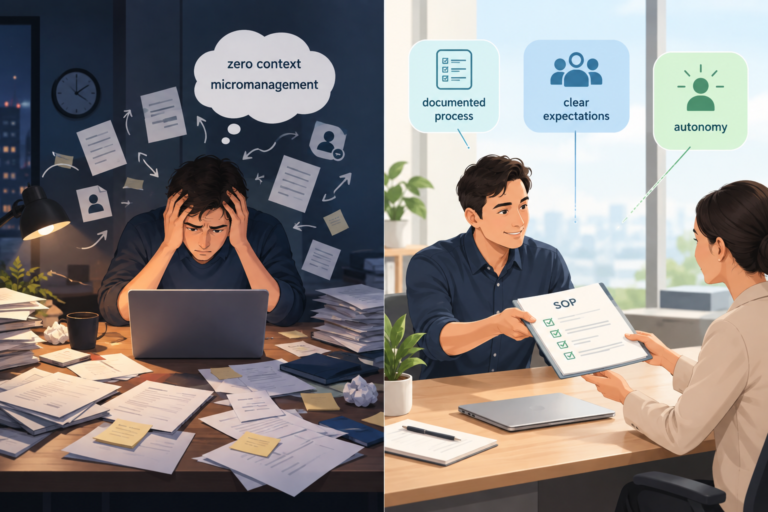
Founder Delegation: Breaking the Burnout-Admin Cycle
It’s late at night, but you’re still at your desk, answering customer support emails that should have been handled hours ago, updating a spreadsheet that someone else could maintain, and wondering why your “strategic planning” keeps getting pushed to next week. You tell yourself it’s because you care more, that nobody else will do it right. But deep down, you know this isn’t sustainable. You’re not a bad founder for feeling drowned in admin work. You’re just understaffed by design.
Recent analysis on founder burnout highlights a critical truth: it isn’t a personal failing or a lack of hustle. It is a structural systems problem. When administrative overload and the inability to delegate day-to-day tasks become the norm, they act as predictable drivers of early-stage startup fatigue. The guilt you feel? It’s normal. But it’s also keeping you stuck.
Why Delegation Feels Impossible for Founders
Think of it like basketball. You’re the point guard who keeps driving to the basket instead of passing. You’re statistically efficient, sure. You can score. But eventually, the defense adjusts, you get tired, and your team never develops the depth to win without you carrying every possession.
Many founders we work with hit this exact wall between pre-seed and Series A. The business is growing, demand is real, but you’re still the one booking meetings, processing invoices, and managing the CRM. The transition from operator-in-chief to team builder feels like losing control of the thing you built.
Before you can fix that, you need to identify exactly what to hand off, which starts with running a simple task audit.
Why Do Founders Struggle to Delegate?
The primary barrier isn’t budget or finding talent. According to Harvard Business Review’s 2024 research on delegation, it’s the fear of losing control or doubting a team’s competence. This hesitation creates micromanagement bottlenecks that ironically stifle the very growth founders are trying to protect.
The phrase “if I don’t do it, it won’t get done right” isn’t a valid business strategy. It’s a growth ceiling.
Effective delegation requires relinquishing direct oversight to build trust. That doesn’t mean abandoning quality standards. It means creating systems where quality can be maintained without your fingerprints on every task, such as by documenting the process using a simple 20-minute SOP template.
Can You Communicate Effectively with Remote Filipino Talent?
Yes. A March 2023 Social Weather Stations survey found that 80% of Filipino adults understand spoken English and 80% can read it, with 69% able to write in English. This nationwide baseline proves English comprehension is deeply embedded in the culture.
When founders finally admit they need help, the worry about communication gaps is a reasonable concern. Clear communication is non-negotiable for remote collaboration.
However, objective data matters more than assumptions. When you layer professional BPO hiring standards on top of that already-high national foundation, the perceived communication barrier virtually disappears. This breakdown helps explain why the reality of working with Filipino talent rarely matches the initial fear.
What Is the True Cost of Hiring an In-House Employee?
According to the Society for Human Resource Management, the average direct cost to hire a single in-house employee is approximately $4,700, covering just recruiting, interviewing, and onboarding. However, the fully-loaded cost typically runs 1.25x to 1.4x the base salary once you add payroll taxes, benefits, and equipment.
A $45,000 salary becomes $56,250 to $63,000 in real cost:
Base Salary: $45,000
Direct Hiring Costs: ~$4,700
Fully-Loaded Multiplier: 1.25x to 1.4x
True Annual Cost: $56,250 to $63,000
This isn’t to say in-house hiring is wrong. It’s to say that flexible remote staffing models aren’t about finding “cheap labor.” They’re about strategically avoiding the heavy fixed-cost multiplier of a Filipino virtual assistant or outsourced admin support model when you’re still figuring out what roles you actually need long-term.
Redeploying Attention, Not Surrendering Control
Delegation isn’t giving up control. It’s redeploying your attention to where it matters most. The admin work drowning you right now isn’t your highest-value activity. It’s necessary work, but it’s not growth work.
The founders who break through aren’t the ones who work harder. They’re the ones who recognize that being understaffed by design is a choice, and that choice has a cost measured in burnout, missed opportunities, and stalled growth.
You built this company to solve a problem, not to become the bottleneck.
Not sure what to delegate first?
Start with a free business audit. We will help you map the admin tasks holding you back, define the exact scope of the role, and find the right professional before you commit to a hire.