Time Zone Difference Outsourcing: Your Hidden Workflow Advantage
It’s 5 PM Eastern on a Tuesday. Your inbox has three new support tickets. The code refactor you started this morning is halfway done. You’ve got a product launch in two weeks and a growing sense that you’re the bottleneck in your own company.
You could stay late. Again. Or you could hand it off to someone who’s just starting their day while you’re ending yours.
Most founders see time zone difference outsourcing as a communication problem. What if it’s actually your biggest operational advantage?
What Is the Synchronous Trap in Outsourcing?
The synchronous trap happens when founders try to do everything in real-time: every question needs an immediate answer, every task waits for review, and the entire operation runs on your availability. This approach creates bottlenecks because growth becomes limited by your personal capacity and time zone.
The data suggests this approach is backwards. A 2024 Gartner report found that 75% of employees are more loyal to organizations that support asynchronous work and clear communication protocols. The companies winning right now aren’t the ones with the most overlap hours. They’re the ones that stopped requiring overlap altogether.
Async-first isn’t a compromise. It’s a structural choice that reduces burnout and creates space for deeper, uninterrupted work.
How Does a Roster Strategy Solve Time Zone Gaps?
Think of it like building a basketball team. You don’t staff five players in the same position. Instead, you build for coverage and complementary skills, ensuring work continues when one unit logs off. This creates 24-hour productivity without burning out your core team.
The Philippines is the perfect example of this in action. It has become the Asia-Pacific region’s outsourcing hub for a reason. The 2023 Kearney Global Services Location Index ranks the country #12 globally, specifically highlighting it as the “business process outsourcing engine” of the region with top-tier scores in people skills, availability, and financial attractiveness.
This isn’t about finding cheap labor. It’s about accessing a mature talent pool that operates on a different clock.
How Does the Overnight Turnaround Model Work?
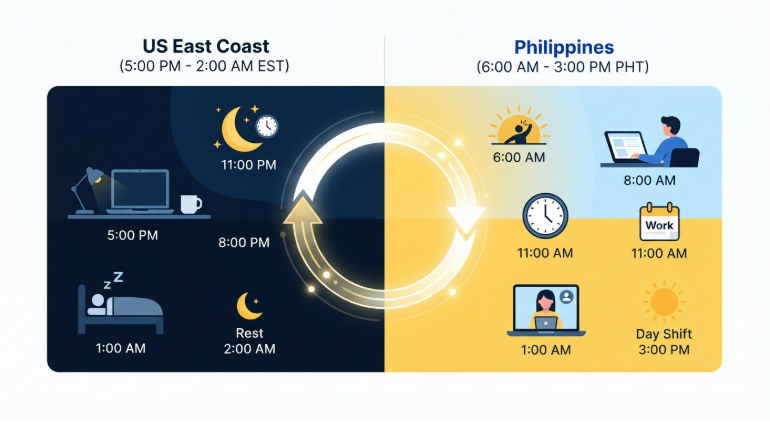
Here’s what the time zone gap looks like in practice:
You submit a task at 5 PM Eastern. Your Philippines-based professional receives it at 6 AM their time. They work through it during their day. You wake up to a completed task at 9 AM Eastern, ready to review and deploy.
For customer support, this means 24/7 coverage without forcing your core team into graveyard shifts. For development work, it means bug fixes and feature builds happen while you sleep. And for content and marketing, it means your calendar stays full without stealing time from strategic planning.
Harvard Business School Working Knowledge analyzed these “follow-the-sun” arrangements and found they effectively eliminate bottlenecks and enable continuous workflow for well-documented, modular tasks. The key word there is “documented.” This model works when you’ve built clear SOPs and handoff protocols, which, if we’re being honest, your business probably needs anyway.
The fear of losing control is real. But control isn’t about watching every keystroke in real-time. It’s about setting clear expectations, documenting processes, and reviewing outputs. The time zone difference forces you to build those systems. That’s not a bug. It’s a feature.
If you’re not sure where to start with documentation, this 20-minute SOP template makes it simple.
Is the Philippines BPO Market Mature Enough to Rely on?
Yes. According to the IT and Business Process Association of the Philippines (IBPAP), the industry is approaching the 2-million-job mark, with 2025 revenue estimated at $40 billion. This isn’t a fragile, experimental market. It’s a highly institutionalized ecosystem with established training pipelines, quality standards, and retention practices.
When you tap into this talent pool, you’re not being an early adopter. You’re plugging into infrastructure that’s already scaled.
The Quiet Advantage
The time zone difference doesn’t disappear just because you hire someone overseas. But it stops being a problem when you stop fighting it.
Many founders we work with discover that the time zone gap gives them something they couldn’t create on their own: uninterrupted focus time for strategic work, extended coverage for customer-facing tasks, and a natural deadline structure that keeps projects moving.
And if you’re worried about making mistakes when you start outsourcing, learn from these common hiring errors before you post that job description.
You don’t need to be available 24/7. You need a roster that is.
Not sure which tasks are ready for an overnight handoff?
Start with a free business audit. We will help you map the workflow, define the exact scope of the role, and match you with the right Filipino professional before you commit to a hire.