Philippines BPO Industry: A Data-Backed Talent Ecosystem
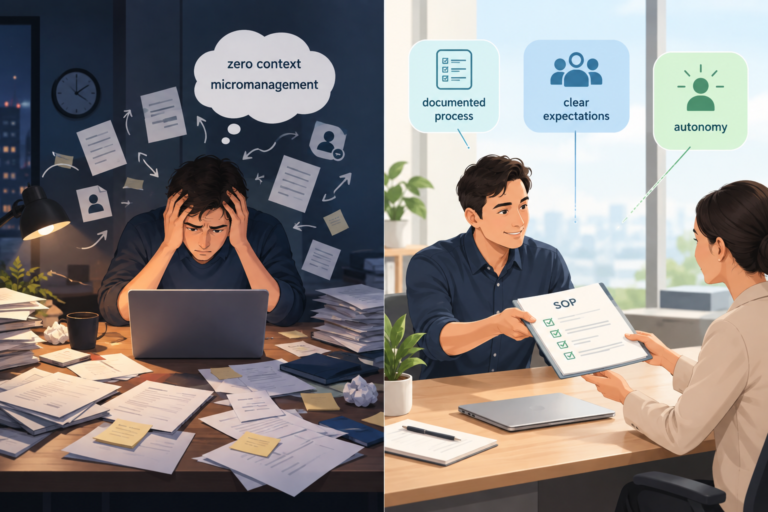
Many founders we speak with hesitate to build an offshore team after one bad experience. They hired a low-cost provider, dealt with constant miscommunication, and ended up spending more time managing the work than if they had just done it themselves. It is a logical reaction.
You protect your business from repeated mistakes. But letting one failed experiment dictate your entire operational strategy means missing a mature ecosystem that global companies have relied on for decades. The Philippines BPO industry is not a gamble. It is a decades-old infrastructure built on data, scale, and proven operational standards.
Is the Philippines BPO Industry Just a Cheap Labor Trend?
No, the Philippine services sector is a foundational macroeconomic engine, not a volatile trend. According to the World Bank’s December 2024 Philippines Economic Update, services exports have become a primary driver of the country’s economic growth. This is not a fringe industry. It is a foundational pillar of the modern Philippine economy, backed by intergovernmental data and decades of sustained development.
The BPO and IT-BPM sectors have continuously built infrastructure, trained talent, and refined operational standards to reach this level of scale. When you outsource to the Philippines, you are plugging into an established ecosystem, not testing a hypothesis.
Where Does the Filipino Talent Pool Actually Come From?
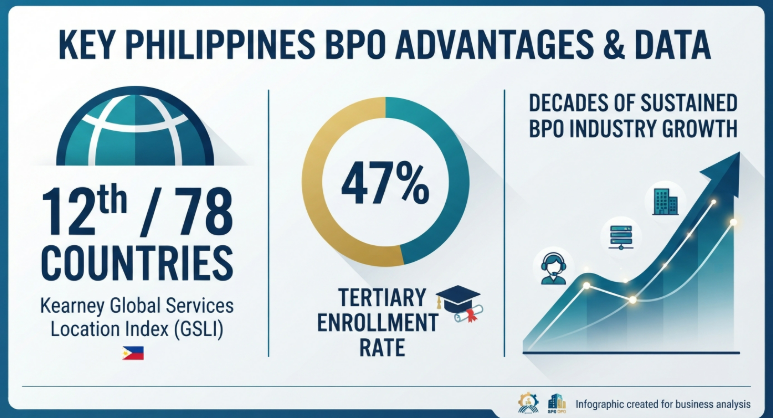
The talent pool is deep, formally educated, and globally ranked, sustained by a strong higher education system. What makes the Philippines competitive beyond cost is its talent regeneration. Kearney’s 2023 Global Services Location Index ranks the country 12th out of 78 nations worldwide. This index evaluates financial attractiveness, people skills, and business environment.
The Philippines earned its position through strong talent regeneration and demonstrated cultural compatibility with Western markets. This pipeline is not accidental. Data from the World Bank shows the Philippines maintains a gross tertiary enrollment ratio of approximately 47 percent.
This means nearly half of college-age Filipinos are enrolled in higher education, creating a massive, continuously replenishing pool of university-educated professionals entering the global workforce annually.
Can Filipino Professionals Overcome Cultural and Communication Barriers?
Yes, because the cultural architecture of the Philippines naturally aligns with Western business expectations. The objection we hear most often is not about cost or technical quality. It is about communication. Founders worry about whether an offshore team will understand their customers or represent their brand.
Data from Hofstede’s cultural dimensions framework shows the Philippines scores 94 on Power Distance and 32 on Individualism. This indicates a highly collectivist culture that prioritizes group harmony, hierarchical respect, and relationship-building over individual achievement.
The culture prioritizes harmony, clear communication, and adaptability. This creates a natural bridge with US business practices. One thing we have seen repeatedly is that teams trained in these global business standards adapt quickly to specific company SOPs, making integration smoother than many founders initially expect.
What Is the Lowest-Risk Way to Start Delegating?
Identify one recurring, low-risk task that consumes 10 to 15 hours of your week but does not require your unique expertise.
If you’re not sure where to start, run a quick task audit to spot the patterns.
That equals roughly 40 to 60 hours a month, or about five to eight full workdays. That is time you can reinvest into growth strategy rather than administrative maintenance. You do not need to overhaul your entire operation overnight. The companies that succeed with offshore talent start small and specific. Customer email triage, social media scheduling, bookkeeping reconciliation, and lead list building are perfect entry points.
These specific functions share a common trait: they follow predictable, repeatable patterns. They do not require your remote hire to make high-stakes strategic decisions or access your core intellectual property. Because the workflows are structured, they are incredibly easy to document in a simple process guide. This makes them the ideal testing ground for a pilot delegation phase.
If a process breaks, the risk to your bottom line is minimal, and the fix is usually just a quick tweak to the SOP. By safely handing off these predictable workflows, you immediately reclaim the mental bandwidth required for high-impact activities. You get your focus back for product roadmap planning, strategic partnerships, and the actual scaling of your business.
The Philippines BPO industry has matured to the point where you can access skilled professionals for these roles without betting your business on an unproven experiment. The data shows the infrastructure exists. The talent is educated and culturally aligned. The question is not whether outsourcing works, but which task you will delegate first to free up your own time for the work only you can do.
Not sure which task to delegate first?
If you are struggling to define the exact scope or role for your first remote hire, our Free Business Audit can help you map out your operational bottlenecks and identify the right fit before you commit to a hire.