Q4 Delegation Strategy: 5 Tasks to Outsource Now
According to a 2023 Ramsey Solutions report, 42% of small-business owners experienced burnout in 2022. If you are reading this while manually updating inventory spreadsheets at 10 PM, with the mid-November peak just six weeks away, you likely know exactly why that number is so high. You are already drowning in daily admin tasks. This is the exact moment a Q4 delegation strategy becomes essential.
What Is a Q4 Delegation Strategy?
A Q4 delegation strategy is a targeted plan to hand off specific, repetitive operational tasks to skilled professionals before holiday volume peaks. This ensures your core team focuses entirely on growth and customer experience through a focused sprint rather than a complete operational overhaul.
When demand grows faster than headcount, the default reaction is to work longer hours. That is a fast track to exhaustion. You are not alone in this bottleneck, but working harder is not the fix.
Why Do Growing Companies Outsource Critical Operations?
Growing companies outsource critical operations to protect their bandwidth and manage costs during high-volume periods. Rather than viewing delegation as a last resort for distressed businesses, modern operators use it as a standard strategic play to maintain efficiency when demand outpaces internal headcount.
Many owners we work with assume outsourcing is only for back-office data entry. The data shows a different reality. According to a 2024 Deloitte Global Outsourcing Survey of over 500 executives, 50% now use outsourced services for front-office capabilities like sales, marketing, and research. The same survey found that 80% of leaders plan to maintain or increase their investment in third-party outsourcing. Delegation is no longer just a cost-cutting measure. It is how modern teams access skilled talent and protect their bandwidth.
Is the Philippine talent pool mature enough for complex tasks?
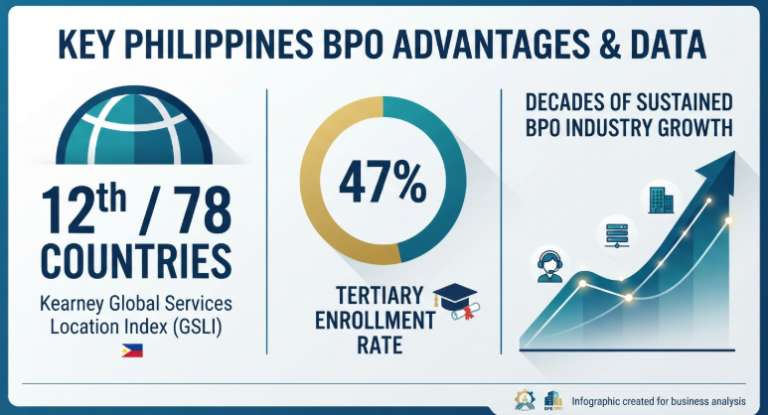
The Philippine talent pool is a highly mature, established ecosystem capable of handling complex operational demands. According to the Philippine News Agency, citing official data from the IT and Business Process Association of the Philippines, the local IT-BPM sector reached $38 billion in revenue in 2024 and employs 1.82 million professionals. This massive market proves the talent pool is a stable, scalable resource, not a risky experiment.
A common silent fear is that artificial intelligence will soon make human outsourcing obsolete. An IMF Working Paper on the Philippine labor market offers a data-driven perspective. The research found that while approximately one-third of the workforce is highly exposed to AI, roughly 61% of those roles are rated as highly complementary, meaning AI is likely to augment rather than replace these workers. The report highlights that college-educated workers in the broader services sector are best positioned to use these advancements. While the report notes that routine tasks face higher exposure, the industry’s massive scale means businesses have access to a deep, adaptable talent pool that is actively evolving to use technology to multiply output.
What Tasks Should a Founder Delegate First?
A founder should delegate high-volume, repetitive operational tasks first, specifically customer-email triage, inventory spreadsheet updates, social-media scheduling, invoice reconciliation, and ad-performance reporting. Handing off these specific processes immediately frees up your time for high-level strategic planning and growth.
Your Q4 delegation strategy does not require a complete operational overhaul. For effective e-commerce delegation, you have a clear window to prepare. Do not try to hand over your entire business at once. Start with a targeted, five-task sprint. Here are high-impact operational tasks ready for immediate handoff:
- Customer-email triage: Filtering routine shipping and product inquiries so your core team only sees complex, high-value issues.
- Inventory spreadsheet updates: Keeping your stock levels accurate across multiple sales channels without you manually cross-referencing data every morning.
- Social-media scheduling: Queuing up your holiday promotional content and community responses so your brand stays visible while you focus on backend operations.
- Invoice reconciliation: Matching payments to orders to keep your cash flow clear and your books tidy before the year-end rush.
- Ad-performance reporting: Pulling the weekly metrics from your ad platforms so you can make strategic budget decisions, rather than getting stuck doing the data entry yourself.
This makes small business Q4 preparation much more manageable. Building a resilient operation is not about working harder in November. It is about assembling the right support structure today. You do not need to hire a full-time local employee to get this done. You just need a clear plan and the willingness to hand off the right tasks. The pullback before the launch is where the real work happens.
Not sure which tasks to hand off first?
Start with a free business audit. We will help you map the workflow, define the exact scope, and identify the right professional before you commit to a hire.