Scaling SaaS Customer Support: How to Grow Without Blowing Up Your Payroll
Hiring locally for Tier 1 and Tier 2 support isn’t a safety net for growing software companies. In fact, it is often the fastest way to stall your product roadmap.
Most bootstrapped founders looking to scale their SaaS customer support team hit the same wall. The product works, demand is growing, but the support queue is drowning the very team that built it. The default reaction is to hire another US-based rep.
But before you post that job description, look at the math. According to the U.S. Bureau of Labor Statistics, the median wage for a customer service representative sits at $39,680 annually. That baseline figure does not include the additional 25 to 30 percent typically added by employer payroll taxes, health benefits, and overhead.
For a founder watching burn rate, adding headcount for basic support isn’t just expensive. It is a strategic distraction from the feature development that actually moves the needle.
What Is the True Cost of Adding Local Support Headcount?
The true cost of adding local support headcount includes a 25 to 30 percent markup on the base salary for benefits and overhead. This pushes the total annual expense to nearly $50,000 per representative before equipment.
This financial reality drastically alters your projections and drains your burn rate. The actual expense extends far beyond the monthly paycheck.
It is the opportunity lost when your product team spends hours on basic onboarding calls. It is your founders buried in support tickets instead of talking to enterprise prospects.
Your product roadmap slips because everyone is stuck in reactive mode.
Where Can SaaS Founders Find Scalable Support Talent?
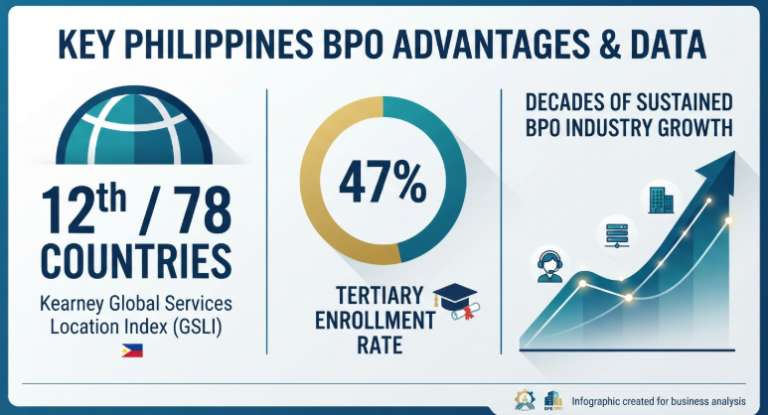
The Philippines ranks 12th globally in the 2023 Kearney Global Services Location Index. This report evaluates 78 countries across 52 rigorous metrics, including talent availability, skills, and financial attractiveness.
The data explicitly notes that the Philippines continues to be a premier business process outsourcing engine. It is not chosen simply because it is cheap. It is chosen because the talent pool is deep, skilled, and accustomed to supporting global tech companies.
This is about accessing a mature, globally validated talent market. Professionals in this market already understand SaaS workflows, CRM tools, and the communication standards required for customer success roles. You can delegate Tier 1 support and user onboarding without sacrificing quality or spending six months training someone from scratch.
Will Offshore Support Compromise Data Security and Compliance?
Offshore support does not compromise data security when governed by strict, enforceable privacy laws like the Data Privacy Act of 2012 (Republic Act No. 10173).
This legislation establishes legally enforceable rules for Personal Information Controllers and Personal Information Processors. An independent National Privacy Commission oversees these regulations and handles breach reporting.
This matters because you are not outsourcing to a regulatory wild west. Filipino professionals working with tech companies operate under this strict legal framework. It provides a clear, enforceable baseline for data protection, removing a major objection to distributed support teams.
What Tasks Should SaaS Founders Delegate First?
Start with repetitive, time-consuming work that does not require deep product knowledge. Tier 1 support tickets, user onboarding sequences, and proactive churn-prevention outreach are the ideal starting points.
These are the tasks that currently consume 12 to 15 hours per week of your team’s time. They do not move your product roadmap forward.
By delegating them to skilled professionals who already understand SaaS workflows, you free up your local team to focus on what only they can do.
Your product team builds. Your sales team closes. Your support team keeps customers happy. That is how you grow without drowning.
Ready to map your support roles?
Not sure which tasks to delegate first or how to structure the role? Start with a free business audit. We will help you identify the hours currently blocking your team’s strategic work and match you with the right professional to own it.