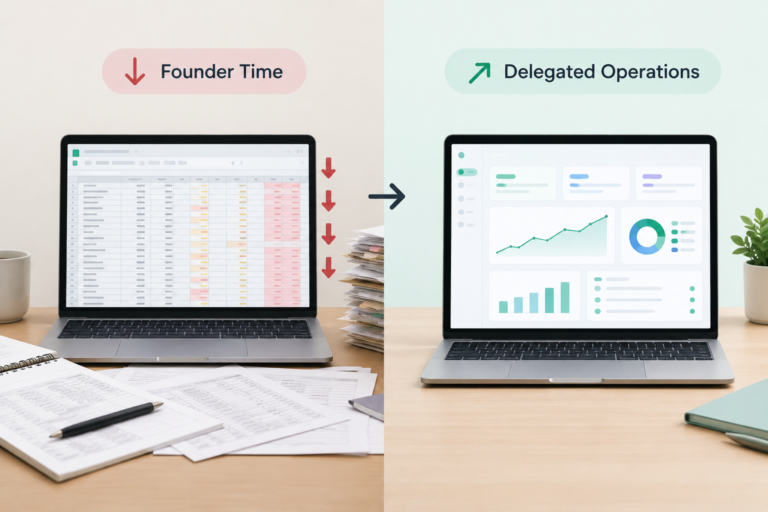
Consultant Delegation: You’re the Product, Who Runs the Business?
Many consulting firm founders hit a predictable ceiling. It rarely happens because client demand dries up. Instead, it happens because the founder avoids consultant delegation, refusing to let go of the work that does not require their specific expertise. They operate under the quiet assumption that maintaining absolute quality means doing everything themselves.
You know the feeling. You just finished a high-stakes client strategy session, only to spend the next two hours adjusting bullet points in a PowerPoint deck, chasing down missing invoice data, or manually entering contact details into a CRM instead of prepping for your next discovery call. You tell yourself it is faster to just do it yourself than to explain it to someone else.
But that choice is quietly draining your capacity to win new business.
According to a 2024 Salesforce report, small business owners lose an average of 96 minutes daily to administrative tasks and context-switching. For a strategy consultant billing at a premium rate, that is an hour and a half of non-billable time evaporated every single day. Over a month, that compounds into dozens of lost billable hours, delayed proposals, and creeping founder burnout.
Why Do So Many Founders Resist Consultant Delegation?
The hesitation usually stems from a fear of losing control over quality. Yet, market data shows that holding onto low-value work is the actual bottleneck.
According to a Clutch survey of small business leaders, delegating is no longer a last resort for struggling firms; it is a standard operational lever for growth. In fact, 83% of small businesses plan to maintain or increase their spending on outsourced services, with 52% regularly using professional firms or agencies to do so.
The primary motivation isn’t just cutting costs, but a near-tie between reducing expenses and bringing specialized industry experience onto the team to fill skills gaps quickly.
Where Does High-Quality, Scalable Support Actually Come From?
It comes from mature, English-proficient talent ecosystems like the Philippines. When founders evaluate offshore support, they often assume it is just a temporary cost-cutting measure. The macroeconomic reality is entirely different.
According to a 2024 International Monetary Fund (IMF) working paper, the Philippine Business Process Outsourcing (BPO) sector generated $35.5 billion in revenue in 2023, accounting for 8.1% of the country’s total GDP. It employs 1.7 million professionals.
This is not a fringe budget hack. It is a mature, English-proficient talent ecosystem that already powers a significant, highly regulated portion of the global economy. Because this sector accounts for 8.1% of the national GDP, the infrastructure, training, and professional standards are built for long-term retention and complex problem-solving, not just short-term task completion.
Filipino professionals are recognized for their adaptability and attention to detail, making them a natural fit for the detailed demands of market research, CRM management, and slide deck formatting.
Will Delegating Administrative Tasks Hurt Quality or Control?
No. In fact, distributed teams often increase measurable productivity. Skepticism about remote work is common, but macroeconomic data tells a different story.
A 2024 U.S. Bureau of Labor Statistics (BLS) analysis of 61 private sector industries found that a 1 percentage-point increase in remote workers is associated with a 0.08 percentage-point increase in Total Factor Productivity (TFP) growth. The data also shows a 0.4 percentage-point decrease in unit office building costs.
When you delegate client-adjacent tasks to a skilled remote professional, you are aligning with a model proven to boost output while lowering operational overhead.
How Do You Start Delegating without Losing Your Mind?
The founders who scale their practices fastest do not hand over entire projects on day one. They isolate the repetitive, client-adjacent tasks and build a simple feedback loop.
Next time you format a strategy deck or clean up your CRM, turn on a screen recorder. Talk through your exact process. Hand that video to your new associate as the standard operating procedure.
You review their first output, give specific feedback, and adjust the process. If the CRM cleanup misses a custom field, show them exactly where to look. If the slide deck formatting is off, correct one slide and ask them to match it for the rest. This is how you build a repeatable system instead of just handing off work and hoping for the best.
Within a week, the associate owns the task completely. You get your high-value billable hours back, and your associate gets a clear, structured role.
You built your firm on the quality of your strategic mind. Protect that asset by ensuring your time is spent exactly where it generates the most value. The rest can, and should, be handled by capable hands.
Not sure which task to hand over first?
Before you commit to a new hire, it helps to map out the exact scope of the role. Request a free Business Audit with our team to identify your biggest time drains and define a clear, low-risk delegation plan tailored to your consulting firm.