The Startup Bus Factor: One Illness Away from Stalling
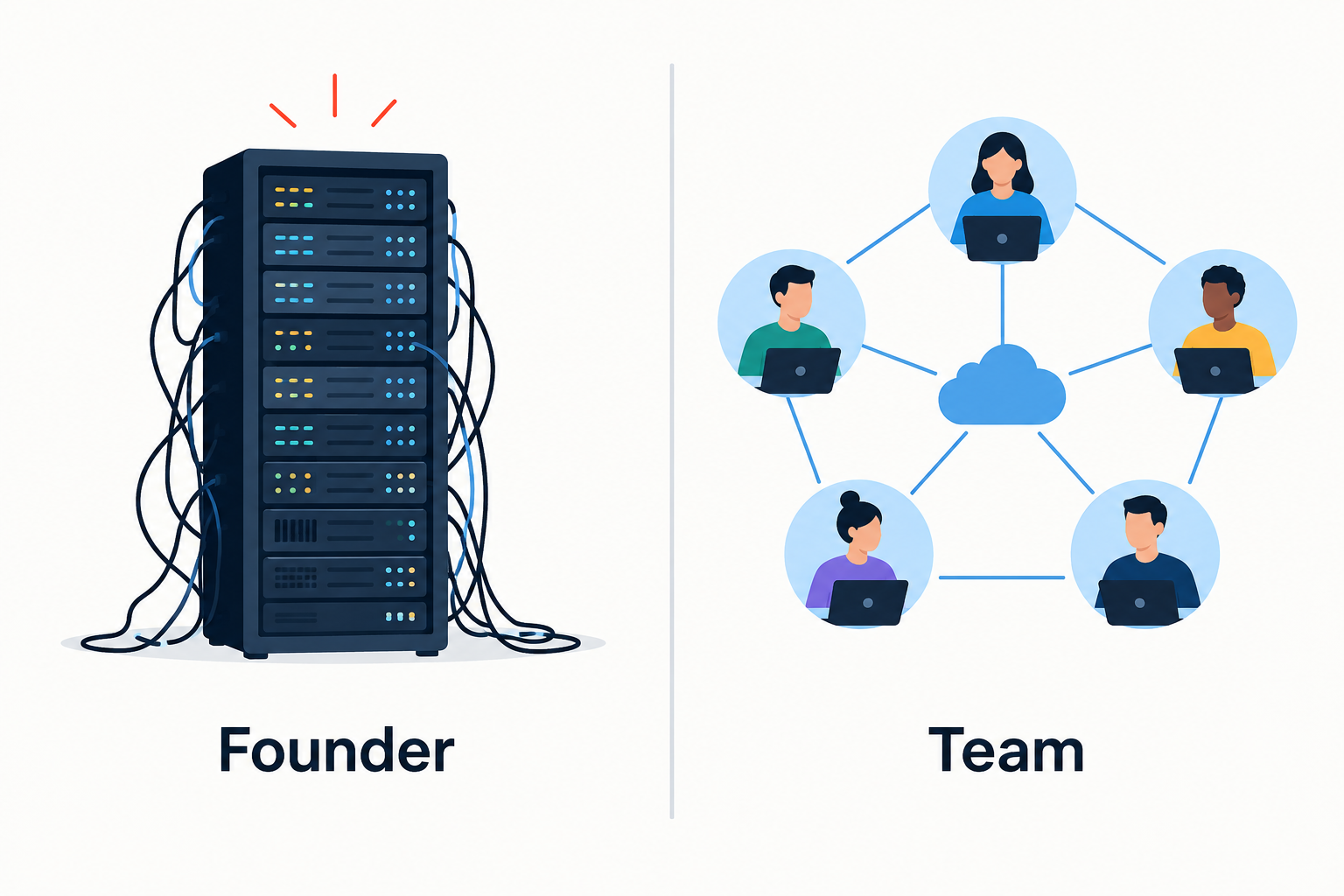
In software engineering, a single point of failure is a system component that crashes the entire operation if it breaks. Engineers build redundancy to prevent this. Yet, most early-stage startups run their entire business architecture on a single point of failure: the founder.
You are not just the CEO. You are the server, the database, and the firewall. If you catch the flu or break your wrist, the business does not just slow down. It stops. Holding onto every operational decision does not protect your startup. It makes you its greatest structural vulnerability.
What Happens When the Founder Is the Single Point of Failure?
Your operational capacity halts the moment you step away. Every critical decision, client communication, and daily workflow relies exclusively on your personal availability. Without documented systems or delegated authority, the business lacks the structural resilience to function independently, leaving your physical presence as the only thing keeping the company running.
In tech, the “bus factor” measures how many team members can disappear before a project stalls. For many digital startups, that number is one. A Milken Institute analysis of U.S. Small Business Administration data estimates that closer to 90 percent of small businesses never reopen after a major operational failure.
An unexpected illness is an operational disaster. If your passwords, client relationships, and daily workflows live entirely in your head, your startup is one bad week away from a total stall.
Can a Distributed Team Actually Handle Core Business Operations?
Not automatically. Competence comes from the system you build, not just the individual you hire. The fear of delegating core tasks usually stems from the assumption that remote workers will need constant hand-holding. In reality, modern business operations are already digitized. Your CRM, project management tools, and financial software are cloud-based. When you pair a structured workflow and clear standard operating procedures (SOPs) with a professional talent pool accustomed to corporate environments, the location becomes irrelevant. The distributed team isn’t guessing what to do; they are executing a defined, documented process. This systematic approach is what allows the Philippine remote-work sector to handle complex, high-value knowledge work for global SMBs, moving far beyond basic data entry.
Will Delegating to Offshore Talent Compromise Quality or Control?
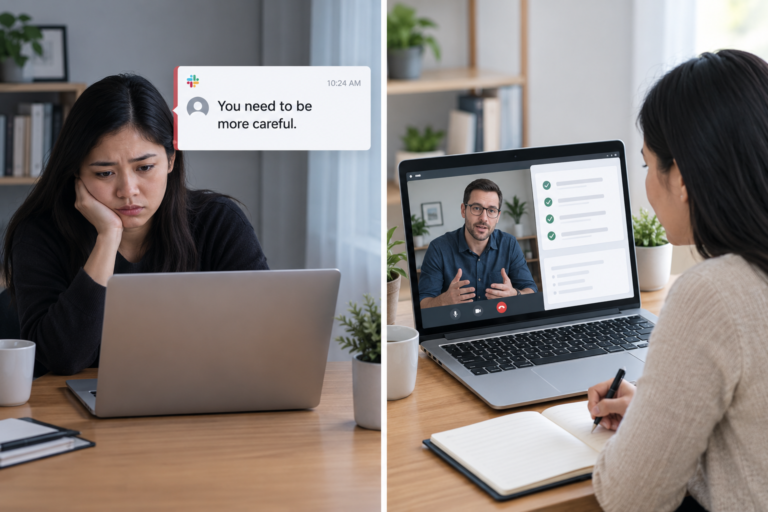
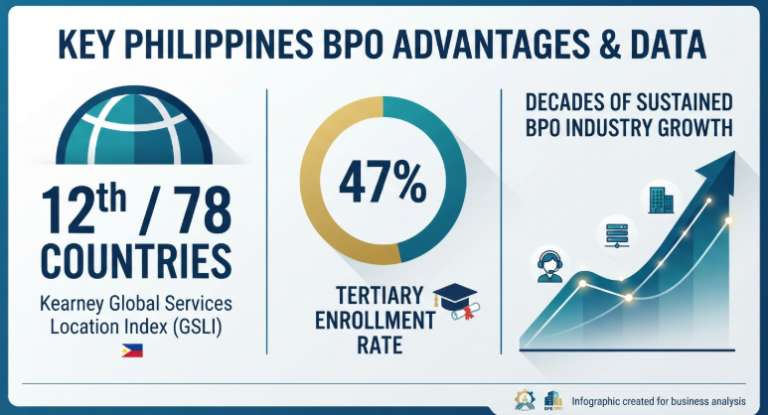
Loss of control happens when expectations are vague, not when the talent is offshore. You maintain quality and control by building clear, documented systems (SOPs), not by doing the work yourself. Once those systems are in place, the baseline capability of the talent pool determines how smoothly they run. According to 2023 data from the World Bank Gender Data Portal, 68.1 percent of the Philippine labor force has attained advanced education. When you pair this baseline of formal training with the country’s “High English Proficiency” ranking in the 2024 EF English Proficiency Index, the friction founders fear is drastically reduced. The distributed team is not guessing; they have the foundational discipline and communication skills required to execute your documented processes accurately.
How Do You Build Operational Redundancy without Losing Control?
You do not need to hand over your entire strategy on day one. Building redundancy requires a systematic, gradual approach that protects your peace of mind while freeing your schedule. Start with a low-risk, high-repetition task.
- Audit your calendar: Identify five to ten hours a week spent on repetitive, low-impact tasks. This is often inbox triage, basic CRM data entry, or scheduling.
- Document the process: Write down the exact steps, expected outcomes, and access credentials. Do not rely on verbal handoffs.
- Hire for the role, not the rescue: Bring on a dedicated professional to own that specific process, rather than a generalist to “help out” when you are already drowning.
When you remove yourself as the single point of failure, the business actually scales. According to a January 2024 Forbes article citing Gallup workplace research, founders with high delegation skills generate 33 percent more revenue and post a 33 percent higher growth rate than those who hoard decision-making.
Delegation is not a surrender of your standards. It is the architectural shift required to turn a fragile, founder-dependent operation into a resilient, scalable business. Your startup deserves a foundation that survives your next vacation, your next flu, and your next growth spurt.
Not sure where to start building redundancy?
Before you hire, you need to know exactly what to hand off. Our Free Business Audit helps you identify the repetitive tasks draining your week so you can define a clear, low-risk role for your first offshore hire.